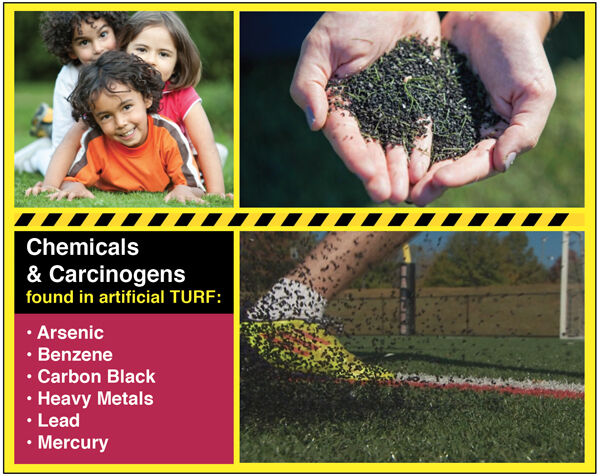
Health Danger
Voters Render Split Decision on Synthetic Turf Playing Fields
"Public sentiment swung the other way in Glen Rock, New Jersey, where voters turned down plans to install an artificial turf field at Faber Field, with 72 percent opposing the project and 28 percent in favor."
Ridgewood High's $98K Field Restoration Project
"Artificial turf typically has to be replaced every 10 years or so. They were first installed at the high school in 2009 and replaced in 2019."
The Toxic Truth Behind Fake Grass
"Testing for specific PFAS in artificial turf revealed the presence of PFOA and PFOS, both of which have been banned from production in the U.S. because they are known carcinogens."
Plastic Turf Fields Are Taking Over America
In 2020, the company said its fields in New Jersey covered more than 60 million square feet — “enough to surface all of Central Park, twice!”
Is Fake Grass Safe?
".....a class of nearly indestructible chemicals also linked to health harms including low birth weight, birth defects and certain types of cancer, has also raised concerns. And in hot weather, synthetic turf reaches higher temperatures than natural turf fields do, which can lead to heat exposure."
Only Natural Grass Can Level The NFL’s Playing Field
"Our union has raised this concern repeatedly over the past few years, and we believe it is now time for a complete overhaul."
Fake grass, real injuries?
"For many, one play during Super Bowl LVI in 2022 on SoFi Stadium’s artificial turf field was all the evidence they needed for the turf’s injurious nature."
What are we gonna do about turf fields?
"More than 90% of pro ballers prefer natural fields, according to multiple years of surveys by the NFL Players Association."
More NFL Injuries Raise Concerns About Artificial Turf
"Over that decade, tears of posterior cruciate ligament (PCL) were about three times more likely on artificial turf than on grass at all three college football levels.""
Artificial Turf and Cancer Risk
“I’ve been at the University of Washington for 21 years,” Griffin said. “And for 15 years I saw nothing. I knew no one with lymphoma. But now, personally, I know six people who’ve had cancer.” By 2010 she had heard of 12 soccer players with cancer and decided to keep a list. She now has a list of 230 soccer players, nearly all goalkeepers, who have played on artificial turf and developed cancers. “Why is this?” she said. “I thought it might be like asbestos, where it took 35 years for people to see the danger.”
A Senate Resolution urging to cease funding synthetic turf field
Synthetic turf components are not only destructive to the environment but also contain a myriad of chemicals known to be harmful to humans, including carcinogens, neurotoxicants, and endocrine-disrupting chemicals.
NJ Legislator Calls for Halt on Artificial Turf
Artificial turf is known to be much hotter than natural grass and often contains PFAS—polyfluoroalkyl substances, also known as “forever chemicals.” These chemicals can seep into groundwater and have been linked to cancer, causing concern in local communities.
Preventing 6 Acres of Toxic Plastic Grass
Local advocates scored a major victory against plastic pollution on Tuesday, November 7, 2023 when voters in Westfield, New Jersey rejected the hefty $11.8 million bond measure needed to fund the installation of six acres of fake plastic grass.
Artificial turf proposals rejected by voters in 2 N.J. towns
Synthetic artificial turf contains semi-volatile organic compounds and heavy metals that can leach into the environment, posing a potential risk to the ecosystem and human health.
Hazard assessment study on organic compounds and heavy metals from using artificial turf
Total carcinogenic risk (R) values for the different age categories were higher than 1E-04 for three football artificial grass fields, which indicated a high cancer risk development probability.
After Aaron Rodgers injury, NFLPA calls for grass in all stadiums
"The players overwhelmingly prefer it and the data is clear that grass is simply safer than artificial turf."
Turf wars raging as N.J. residents face off over replacing grass with artificial fields
The showdown in Scotch Plains is one of several fights over artificial turf being waged across New Jersey as some residents raise concerns about the environmental, health and safety costs of ripping out natural grass and replacing it with artificial fields.
THE 100-YARD
DECEPTION
A six-month NJ Advance Media investigation found FieldTurf, the top U.S. maker of artificial sports fields, made millions selling high-end turf to taxpayers in towns and schools across N.J. and the U.S. after knowing it was falling apart.
Artificial turf linked to cancer deaths of six Phillies ball players
The lawn replacement contains large amounts of toxic chemicals. They are called “forever chemicals” because they don’t naturally break down, and are linked to cancer, liver problems, thyroid issues, birth defects, and kidney disease.
Boston bans artificial turf in parks due to toxic ‘forever chemicals’
All artificial turf is made with toxic PFAS compounds and some is still produced with ground-up tires that can contain heavy metals, benzene, VOCs and other carcinogens that can present a health threat.
Not Getting Smarter All These Years Later
Ridgewood NJ, according to sources storm damage during Hurricane Ida to the synthetic turf at the RHS Stadium and Stevens Field will cost taxpayers $150,250.00 to repair.
Artificial Turfgrass Contains Toxic PFAS Chemicals, Lab Tests Reveal
"These chemicals belong to a class of chemicals that have been associated with various health issues including cancer, which adds to the growing concern regarding the artificial grass replacement."
Be Aware of Artificial Turf Hazards
"While these advantages have powerful appeal, synthetic turf comes with an unfortunate host of established and potential health and environmental risks."
The Disadvantages of Artificial Grass
"Artificial grass contains a known allergen latex and a host of phthalates, or plasticizers. The plasticizers break down and release potentially harmful substances that affect the kidneys, lungs, reproductive organs and liver if breathed in or accidentally ingested."
Does playing on artificial turf pose a health risk for your child?
"Also, artificial turf is often treated with biocides, as turf has been associated with increased risk of infections from methicillin-resistant Staphylococcus aureus. MRSA is a dangerous infection..."
Is Artificial Grass Toxic?
"The organization also notes that cases of cancer among young people who
have played on these fields have continued to increase – mainly
lymphomas and leukemias, mostly among soccer goal keepers."
Does artificial turf make sense?
"It is a myth that artificial turf is cheaper than natural grass. Artificial turf fields must be vacuumed to remove all leaves and debris. They must have the fibers brushed up regularly and occasionally be deep raked to loosen up the infill. Fields must also be disinfected, washed, and have loose seams repaired."
Fields of Waste
"They are alarmed by some studies calling out the potential health risks of crumb rubber and the exposure of young people to cancer-causing chemicals, lead and other dangerous toxins."
3 Dangers of Artificial Turf
"And kids playing on these fields are exposed to leaching and off-gassing chemicals known to have carcinogenic, repro-toxic, mutagenic, and endocrine-disrupting effects."
How old turf fields raise potential environmental, health concerns
"As fields are replaced, billions of pounds of rubber and synthetic fiber are piling up because the U.S. has no plan for disposing of this product."
Paper: Old turf fields raise environmental, health concerns
"Despite being touted as a completely recyclable alternative to grass, there are no companies in the U.S. that can completely recycle them, according to a trade association president."
Only Natural Grass
"Players have a 32% higher rate of non-contact knee injuries on turf and a staggering 69% higher rate of non-contact foot/ankle injuries on turf compared to grass."
Players Prefer Playing On Natural Grass
"93% said playing on artificial turf would shorten their careers; 91% said artificial surfaces cause more soreness and fatigue. And 85% said infill systems were more likely to contribute to injury."
Dangers of Artificial Turf